

I Refuse to Be An Object
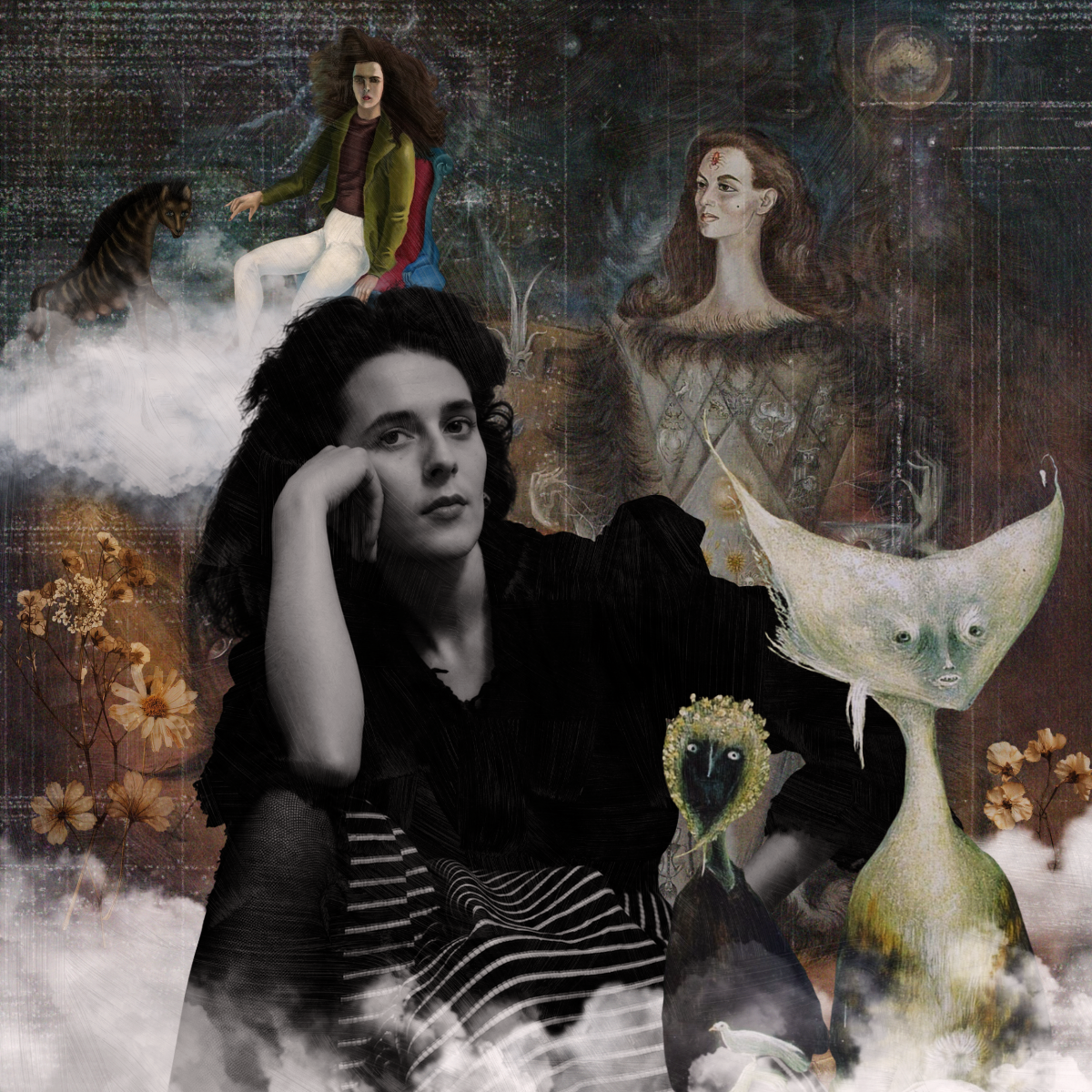
A pale woman sits next to a hyena in an empty room; her large hair fills the canvas as they both stare at the viewer, inviting them into their hunger. Representing Leonora Carrington, a British-Mexican artist known for her occult- and alchemically-inspired paintings, the hyena embodies not only the undomesticated nature of Carrington’s personality, but also the breaking of traditional gender norms. The hyena combines both the masculine and feminine and transforms Leonora’s self-portrait into a depiction of her own body and life, rejecting the conformist nature of society’s view of women in art.
Born on April 6th, 1917, to a wealthy family in Lanchester, England, Carrington’s childhood was anything but standard. The opposing forces of Carrington’s wild and free nature versus the gender norms placed upon her created a volatile mix of passion and resistance, leading to her being thrown out of two schools and being sent to an art school in Florence, where she was first introduced to surrealism. This artistic movement, marked by a breaking away from traditional depictions of reality, captivated her and pulled her into the world of the occult and alchemy.
Carrington’s work focused heavily on what it meant to be a woman and provided commentary on how female sexuality was depicted in art. She often noticed that women were depicted as lacking agency over their own sexuality, and instead were objects onto which sexuality was placed. Carrington strongly opposed this depiction of women, stating “[she] didn’t have time to be a muse… [she] was too busy rebelling against her family and learning to be an artist.”
Many of her paintings found their home in the world of the occult and alchemy as well as her family’s Mexican heritage, from which she drew heavy inspiration from Mayan mythology. These influences all had a common theme of transformation and breaking away from traditional gender norms, as well as emphasizing the elevation of one's spirit rather than body. In Carrington’s painting And Then We Saw the Daughter of the Minotaur, two boys are surrounded by a fantastical world full of anthropomorphized animals, an otherworldly depiction of a goddess, and glowing orbs. These images are used to break the viewer away from the natural world and transport the viewer into a hypnotic out-of-body experience.
Carrington’s depiction of women and female sexuality almost entirely removes the standard portrayal of naked women—figures to be viewed but not empathized with. Instead, Carrington wraps the viewer in the perspective of the woman whose sensuality is expressed through her. She transforms what it means to be a woman and how women are depicted in art, applying surrealist and occult elements to elevate the viewer's notions of reality. Carrington's art transforms what it means to be a woman and how people view relationships, and captivates viewers through intriguing depictions of a metaphysical world.
Written by Erik Reichmeider, Design: Jelena Nguyen