

Walk Like A Girl
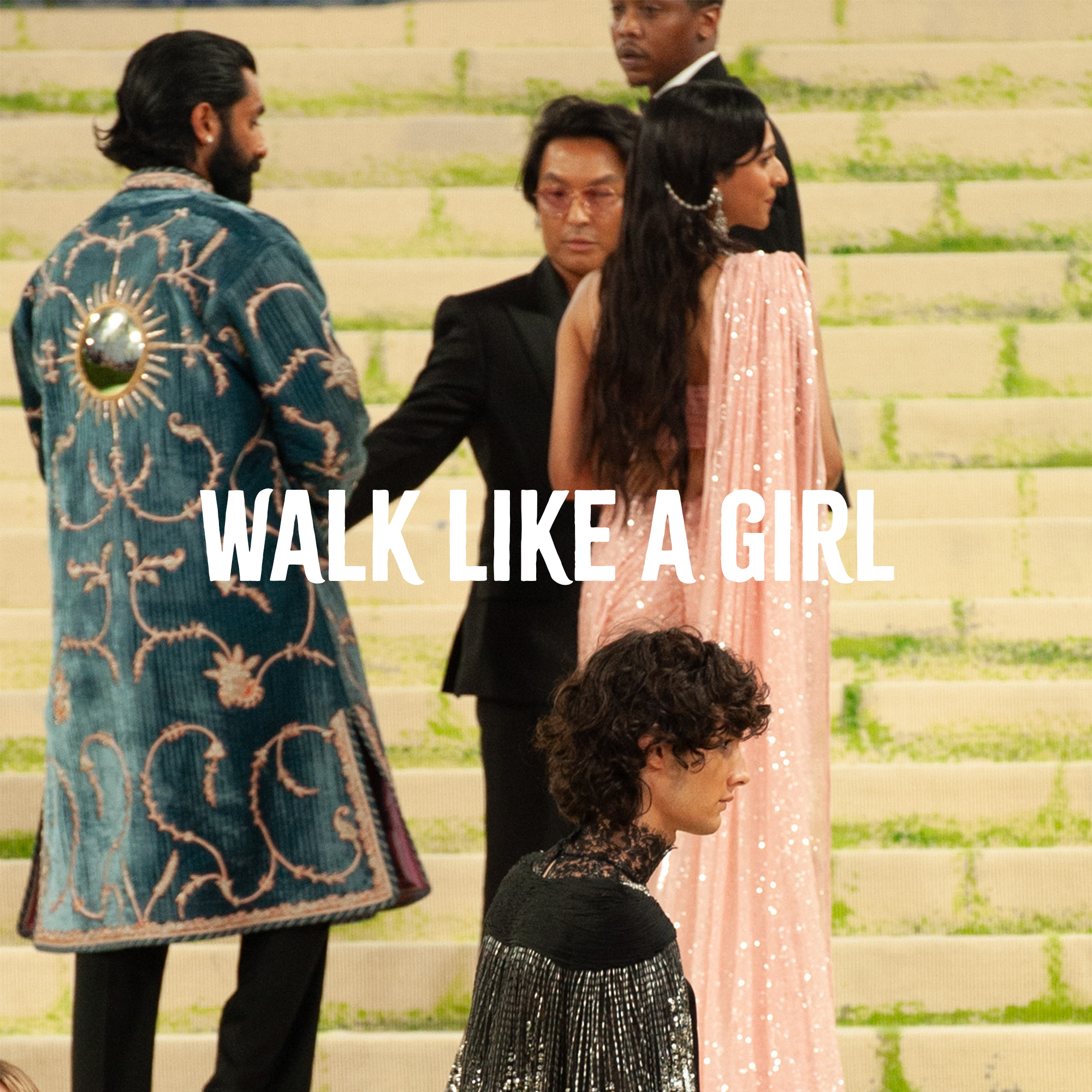
Renowned for weaving elegant style with powerful social commentary, Prabal Gurung has become a significant force in contemporary fashion, reshaping womenswear with his artistry and activism. Gurung has dressed the world’s most high-profile women, from cultural icons such as Lady Gaga, Beyoncé, Anok Yai, Priyanka Chopra, and Zendaya, to political leaders like Kamala Harris, Kate Middleton, and Michelle Obama. Gurung’s focus on dressing women is deeply rooted in his belief that fashion serves as a potent form of empowerment. As he shares in his 2025 memoir Walk Like a Girl, he sees clothing as more than just fabric—it is armor, a means for women to assert their individuality in a world that often tries to confine them, a belief deeply inspired by the strength of his mother during his upbringing.
Throughout history, fashion has served as a visual language reflecting society’s ideas about masculinity and femininity. At first glance, many think that clothing is merely a garment to be worn, designed to be practical. However, it is in the details that binary norms are made clear, revealing how fashion both reinforces and challenges rigid identities.
Though societies developed divisions of labor based on biological differences (e.g., physical strength and childbearing), these practical divisions became culturally codified into fixed roles and traits—men as protectors and providers, women as caregivers and nurturers—evolving into the stereotype that all boys must be assertive and all girls must be nurturing. Children who didn’t fit these molds, like Prabal Gurung in his youth, often endured bullying and isolation; in his memoir, he recalls being called “a sissy” and “effeminate.” Growing up as a queer boy in Nepal and India, he often felt “like an outsider” in the very schools and communities where he spent his formative years (Gurung 2025). Though the phrase “walk like a girl” was often used to mock him as a child, he now reclaims it as a symbol of strength rather than weakness. For him, “walking like a girl” means moving through the world with courage, softness, defiance, and vulnerability, the very traits of his mother, whom he looked up to. Gurung calls her the “hero of his book,” believing that his admiration for women shapes both his feminism and his design philosophy (Gurung 2025).
From an early age, Gurung recognized the spark of creativity within him and chose to pursue fashion at the National Institute of Fashion Technology (NIFT) in New Delhi, later crossing continents to refine that vision at Parsons School of Design in New York City. Creative industries, especially fashion, are thought to be progressive and open-minded because of their inherent need to challenge established norms. This spirit of innovation and nonconformity might suggest that a young Prabal Gurung, who struggled to fit in among his hypermasculine, performative peers, would naturally find acceptance in pursuing the American dream. Yet, even within New York City’s dynamic fashion scene in the 1990s, Gurung encountered racism and harsh criticism for his expressive personality and sexual orientation, partially fueled by jealousy from peers who resented his early success. These experiences of exclusion and judgment, however, simply bolstered Gurung’s drive for success and shaped the way he approached fashion and self-expression. Rather than conforming to the expectations of those around him, he allowed his work to become a reflection of his resilience and his exploration of identity (Gurung 2025).
Gurung’s designs draw from his cultural upbringing—born in Singapore, raised in Nepal, educated in India, and ultimately shaped by life in New York City. Prabal Gurung’s Fall/Winter 2026 collection, presented during New York Fashion Week and titled “Home, Sweet Home?”, questions the concept of a true home by drawing inspiration from his childhood memories, Nepali heritage, and the cultures of the various places he has resided in. This collection juxtaposes sharp blazers and overcoats—meant to evoke Catholic schoolboy uniforms from Gurung’s youth—with softer, more expressive elements such as lace, draped fabrics, chiffon, and organza, treating them as a protective “second skin.” Other pieces feature distinctive, sculpted cuts from body-hugging fabrics like silk, elegantly accentuating the female form. Some pieces are more versatile due to their simplicity, while others are ornamented with pearls and diamonds—Gurung’s “personal stones that [he wears] for protection.” Designed for cooler weather, the collection features a palette of muted, darker hues and rich jewel tones. Overall, it presents the theme of finding sanctuary amid uncertainty, the strength in softness: “the resilience of women back home in Nepal and here, about all of us coming together.”
Gurung’s Spring/Summer collections naturally carry different stylistic and narrative decisions. Spring/Summer 2023, in particular, features sheer fabrics and elegant layering, evoking a sense of both revealing and protecting the female body. Bold pops of pink, orange, yellow, and blue welcome the renewal of spring with a contemporary, cosmopolitan approach. These, balanced with lace, mesh, and muted neutrals, embrace themes of fragility and openness. This is especially fitting, considering the collection is titled “Voyeurism.” However, this “voyeurism” does not have sexual connotations, but rather refers to “the act of watching people without seeing them,” pointing to the common social blindness of reducing individuals to surfaces. Many of Gurung’s collections push directly against this flattening gaze by using garments that capture the various elements that define a woman and by incorporating political messaging and diverse casting in his runway shows. By doing so, he forces the audience to confront the person, the fashion, and the background, not just consume the image. As Gurung puts it, “This is my celebration of those who are so often watched—on subways, across the bridge, in corners—and never seen. The ones whose names you never know—but whose defiant actions you can never forget. To the ones who are demonized because they are not understood in genders, in colors, in places, and in values that others know: on this runway, know that we are no longer watching you—we are seeing you. Why? Because we are not for them. We’re ours.”
Prabal Gurung has been a longtime advocate for a shift toward a more matriarchal society—not in the sense of women dominating men, but in elevating the values traditionally associated with femininity. He emphasizes that true equality means balancing the capabilities of men and women, but with a deliberate focus on qualities often labeled as “feminine” and “matriarchal”—such as empathy, emotional receptivity, vulnerability, fortitude, and collaboration. These traits have historically been undervalued and dismissed as submissive or secondary, while masculine traits—like competitiveness, assertiveness, and independence—are celebrated as the ideal for both modern men and women to emulate, especially in corporate America. This imbalance, Gurung suggests, fuels a cutthroat culture, especially in high-pressure creative environments like the fashion industry, where individuals consistently aim to surpass others with relentless ambition. Rather than fostering true progress, this overemphasis on traditionally masculine traits perpetuates division, burnout, and a lack of emotional connection in today’s complex world. Gurung’s vision invites us to redefine strength not as the absence of vulnerability, but as the courage to embrace it.
“I believe existing in this manner is the only way we can save this world.”
Sources:
Gurung, P. (2025). Walk like a girl: A memoir.
Written by Nidhi Suraparaju, Design: Jili Dai